Blog / Verdicts
Train or transfer to the Alps: the maths for a group with ski bags
A transfer is one fixed price for the car. A train ticket is a price per head. Where the crossover lands for a group with ski bags, on three real routes.
published 17 Sep 2026

A private transfer is one fixed price for the vehicle. A train ticket is a price per head, and it multiplies. The crossover lands at three to four travellers, and ski bags, a station change and a missed last bus all move it earlier. Two adults on a good line should take the train. Four people with skis, landing in the evening, should do the division first.
This piece works the decision through on three airport routes where the research already has a verdict: Geneva Airport to Zermatt, Munich Airport to Sölden, and Zurich Airport to St. Anton am Arlberg. Every timetable fact below was read from the operator’s own page on 17 September 2026.
Is the train or a private transfer better for the Alps?
It depends on how many of you there are.
Start with the case for the train, because on a lot of these journeys it is not close. A direct Eurostar Snow Train from London to Bourg-Saint-Maurice runs on winter Saturdays, 19 December 2026 to 28 February 2027, with no change and no road leg at all. Skis and a snowboard travel free on top of the standard two bags. Two adults on that train are having a better afternoon than two adults on the autoroute, and there is no honest way to argue otherwise. The same goes for Zermatt, where the train runs into the village itself and the road does not.
The catch is arithmetic. A train ticket is priced per person and a private transfer is priced per vehicle, so the two scale in opposite directions, and the whole argument lives in that one sentence.
Where does the maths flip from per head to per car?
At three to four people, on most routes.
Do the division rather than the comparison. One fixed price for the car, divided by the number of heads in it, is the number that goes up against a per-person fare. For four travellers the fixed price has to beat four fares, so the public cost per head only has to be above a quarter of it before the transfer stops being the expensive option. For three, a third. That is arithmetic rather than a survey finding, which is why the answer changes on the day a third person joins the trip and not on the day the fares change.
There is a second multiplication underneath the first, and it is the one that gets missed. A public journey to an Alpine gateway is rarely one ticket. It is an airport rail leg, then a long-distance leg, then a valley bus, and each of those is priced per person in its own right. So the per-head figure you are testing against a quarter of the vehicle price is not a fare, it is a sum of two or three fares, and it grows with the number of legs as well as with the number of people. A route with a single through train and a route with three changes are not the same purchase even when the headline fare looks similar.
Figures that circulate widely put the crossover at four or more people. That is roughly right, and it hides the part that matters: the crossover moves with the route, not only with the group. Add a change of station, a bag nobody can lift onto a rack in ninety seconds, or a last bus that has already gone, and three people is already past it.
| What you are comparing | Train, plus the last mile | Private transfer |
|---|---|---|
| How the price scales | per person, on every leg | one fixed price for the vehicle |
| Changes | one to three on these routes | none |
| Who carries the bags | you do, across every platform | the driver, once |
| Door to door | the timetable, plus every wait between legs | one leg, no waiting between legs |
| If the last bus has gone | a taxi you did not budget for, or a night at the gateway | the car waits for the flight |
| A Saturday changeover | the bus is full before it reaches you | the road is slower for everyone |
Read the first row on its own and the train wins on two people. Read the four rows below it and it stops winning on four.
Nobody in a car changes platform.
Geneva Airport to Zermatt: does the train reach the door?
Yes. Into the village, not near it.
Zermatt is car-free, and the Matterhorn Gotthard Bahn terminates in the middle of it, 5 minutes on foot from the centre. From Geneva Airport the route is one change at Visp and then the run up the Matter valley. For two people with a bag each, this is the trip.
Figures that circulate widely describe a private transfer from Geneva Airport “to Zermatt”. No road vehicle reaches Zermatt. Road access ends at Täsch, 6 kilometres below the village, and the driver, the taxi passenger and the transfer passenger all finish the journey on the same shuttle train, which runs every 20 minutes between 05:55 and 21:55 and takes 12 minutes.
So the transfer does not buy a door on this route. It buys one vehicle as far as Täsch and no change at Visp, and the arithmetic runs the way it runs everywhere: divide the fixed price by four and it looks reasonable, divide it by two and it does not.
Where it turns is the group and the bags. Train passengers do not change at Täsch at all, because the Matterhorn Gotthard Bahn runs through from Visp; transfer passengers do. For two people the train has one change and the transfer has one change, and the train is cheaper. For four with skis, boots and a week of luggage, the transfer is a vehicle with no platform in it.
Same last train either way.
Munich Airport to Sölden: why does the group case win there?
Sölden has no station.
The nearest one is Ötztal Bahnhof, at the mouth of the valley on the Arlberg line. From Munich Airport the public route is the S1 or the S8 into Munich Hauptbahnhof, about 40 minutes with a departure roughly every 10 minutes, then a Railjet to Innsbruck, then the Arlberg line west, then the Postbus 320 up the valley. Sölden is 55 minutes on that bus. Obergurgl is 80.
Three changes, four legs, and every leg priced per head.
The transfer is one price for the vehicle, from €260 on TransferBnB. Four people make that €65 each, which is the point at which the argument is over. Two people make it €130 each, which is where a couple travelling light should still take the train and not think about it again.
The valley bus decides the rest. Its winter frequency and its last departure are not published on a timetable we could read, so read the operator’s own before you book an evening flight into Munich.
Zurich Airport to St. Anton am Arlberg: what if you land in the evening?
The train is the right answer until about dinner time.
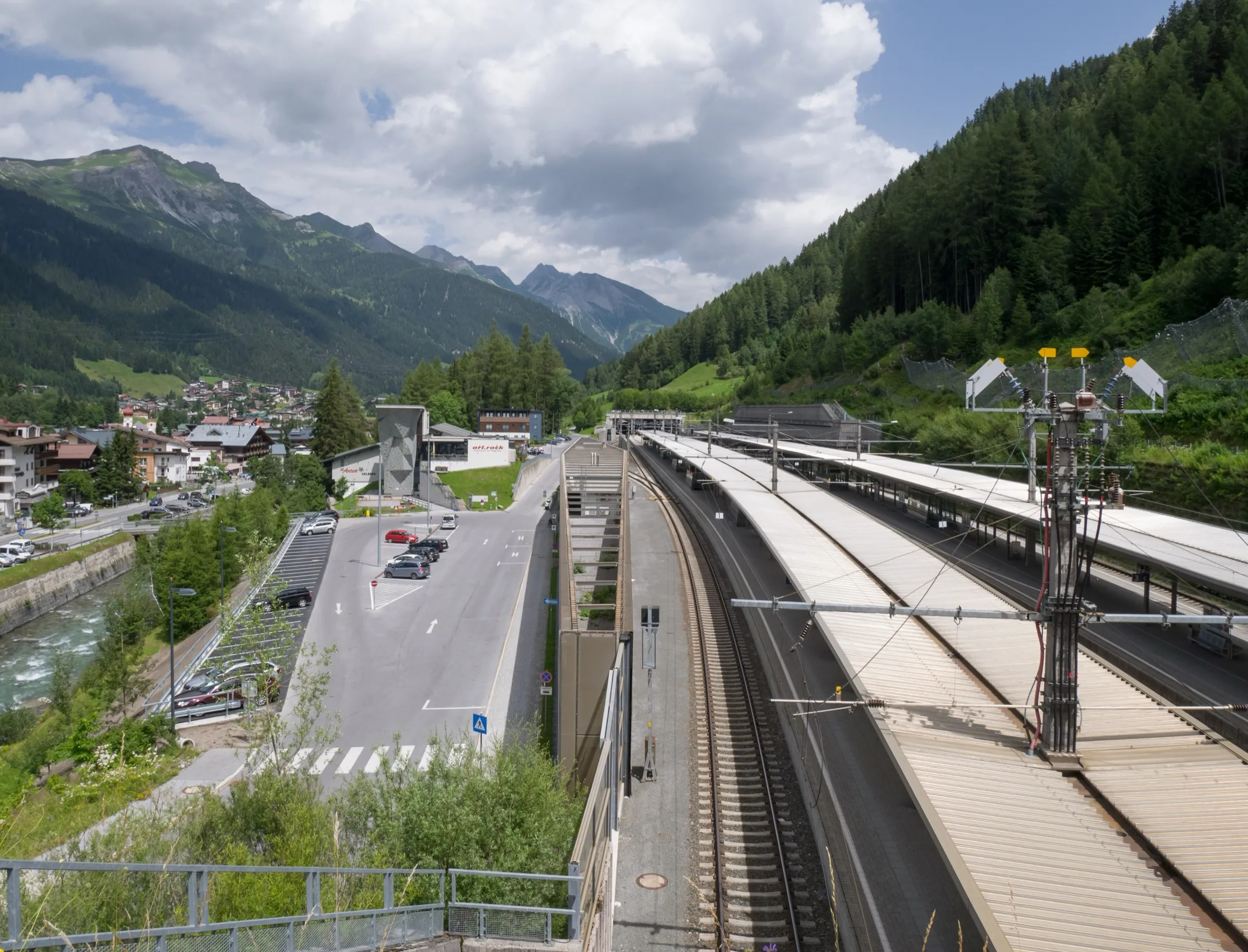
St. Anton am Arlberg is one of the best-served ski stations in the Alps, with seven direct Railjet connections a day to Zurich and seven to Vienna, the station in the village, and the Galzigbahn base a 12 minute walk away. From Zurich Airport the route is a short hop to Zurich HB and then the Railjet east. For a midday arrival the train is not a compromise, it is the better trip.
The evening is a different question. The village bus and the ski bus both stop for the night, and a clock time for the last one circulates on route planners without appearing on the operator’s own timetable, so this site does not print it. Read the timetable page for the dates you are travelling. The transfer, for comparison, is from €180, which is €45 a head for four people and €90 each for two.
A 12 minute walk with ski bags is a 12 minute walk. At ten at night in February, in the dark, with a five-year-old and a boot bag, it is a different 12 minutes.
| Route | Where the train stops | The gap the train leaves | Transfer, from |
|---|---|---|---|
| Geneva Airport to Zermatt | Zermatt, in the village | None. Road traffic stops at Täsch and joins the same shuttle | take the train |
| Munich Airport to Sölden | Ötztal Bahnhof, at the valley mouth | Postbus 320, 55 minutes up the valley, last departure not published | €260 |
| Zurich Airport to St. Anton am Arlberg | St. Anton, in the village | None by day. After the last bus, the walk from the station | €180 |
Read the third column before the fourth. The price only decides the routes where the third column says there is a gap at all.
Can you take ski bags on the train, and whose rules apply?
Every operator on these routes carries skis free.
The rules differ in the detail, and the detail is what catches a group out:
- Eurostar carries skis or a snowboard free in a protective case with straps, on top of the normal two-bag allowance at 85 cm a bag, with a ski rack in each carriage.
- SNCF takes one pair of skis per passenger as hand luggage in a labelled bag, and a snowboard in a case up to 90 x 130 x 50 cm. The binding clause is the other one: you must be able to carry everything you brought, at once, by yourself.
- SBB carries skis, boots, poles and snowboards free in the ordinary racks. Its separate luggage services, door to door or station to station, treat a ski bag as a 23 kg item like any other and need it packed and labelled.
- ÖBB carries skis, snowboards and poles free even when they exceed the 90 x 60 x 40 cm hand-luggage limit, Railjet included.
- Nightjet puts them in the multifunction car, in a dedicated area, at no extra cost. Nothing travels loose in a corridor.
Figures that circulate widely quote an ÖBB cap of one set of equipment per passenger, or a supplement for carrying it. The fare rules print neither, read on oebb.at on 17 September 2026. What they do print is the limit that actually bites, and every other operator prints it too: you carry it yourself.
Four adults with skis, boots and a suitcase each is sixteen items and eight hands.
Can you send the ski bags ahead instead?
In Switzerland, yes, and it changes the answer.
SBB runs two luggage services that comparisons of this kind almost never mention. The door-to-door one collects from a home or hotel address and delivers to the address at the other end, normally two days later, with an express option that arrives the same evening. It takes up to 16 items, skis, snowboards and sledges included, at 23 kg each, packed and labelled with a name, an address and a phone number. The station-to-station version is the cheaper shape of the same idea: hand the bags in at a station that offers it, collect them at the far end, again usually two days later, with free storage on the arrival day and for four more days after that.
That is the one option that dissolves the argument rather than settling it. Four people who put the skis on a luggage service are four people with hand luggage, and four people with hand luggage belong on the train.
The limits are real, and they are why it is not the answer to every route on this page. It covers Switzerland and Liechtenstein, so it does nothing for the Ötztal or the Arlberg. It wants two days of slack at both ends, which a Saturday-to-Saturday week does not always have. And it is a second booking to get wrong, on a day when the first one already has a flight in it. Where it fits, though, it beats both columns of the table above.
What does a Saturday changeover do to both sides?
Saturday is the day the entire Alps changes over.
Chalets and apartments turn over on the same day, in every valley at once, so the approach roads, the connecting buses and the taxi rank at the gateway station all peak inside the same few hours. A resort’s advertised bus frequency is not a guide to how full that bus will be when it reaches you. Bourg-Saint-Maurice is the clearest case, because the Eurostar Snow Train arrives on exactly that day and the whole Tarentaise funnels down one road behind it.
Both options get slower on a Saturday. Only one of them has a seat and a place for the bags reserved in your name.
One more date belongs in the planning. Every European railway resets its annual timetable on 13 December 2026. Every clock time above, and every clock time you read anywhere else this autumn, needs checking again after it.
When does a private transfer actually win?
Four cases. Outside them, take the train.
- Three or more of you with full equipment. The per-head fare has passed a third of the fixed price, and the platform changes have stopped being free.
- You land after the last onward bus. A missed last bus is a taxi you did not budget for, or a night at the gateway you did not book.
- A Saturday changeover. The bus is full and the road is slow either way; the difference is an hour spent standing in a queue or an hour spent sitting in a vehicle.
- The last mile is taxi-only. Some gateways have no public onward leg after the station at any hour of any day, and no amount of planning creates one.
None of those four is about comfort. Each one is a leg the train does not cover, and a leg it does not cover is a leg you are paying for anyway.
When the last mile is the problem
Three or more of you with ski bags, a late arrival, or a Saturday changeover: the onward bus is where the train journey stops being easy.
Private transfer
One fixed price for the whole car, from the airport to the door.
TransferBnB and this site are both run by Green Wire Media. This link is ours, not a paid placement.
Frequently Asked Questions
Is it cheaper to take the train or a private transfer to the Alps?
For one or two travellers, the train, on almost any route with a station near the resort. A transfer is one fixed price for the vehicle, so it divides. A train ticket is per person, so it multiplies. The crossover lands at three to four people, and earlier if you are carrying skis or arriving after the last bus.
At what group size does a private transfer become cheaper than the train?
Three to four. For four travellers, compare the public cost per head against a quarter of the fixed vehicle price; for three, against a third. Above that share the transfer is the cheaper option, before counting who carries the bags across the platform.
Does the train go all the way into Zermatt?
Yes. Zermatt is car-free and the Matterhorn Gotthard Bahn terminates in the village, a five-minute walk from the centre. No road vehicle gets closer than Täsch, 6 kilometres below, where every driver and every transfer passenger changes to the shuttle train. It runs every 20 minutes between 05:55 and 21:55 and takes 12 minutes.
Can you take ski bags on the train for free?
Yes, on every operator on these routes. Eurostar carries them free on top of its two-bag allowance, SNCF as hand luggage in a labelled bag, SBB free in the ordinary racks, and ÖBB free even above its 90 x 60 x 40 cm hand-luggage limit, Railjet included. You carry them yourself, which is the rule that decides a group of four.
Is there a train to Sölden?
No. The nearest station is Ötztal Bahnhof on the Arlberg line, and the Postbus 320 continues up the valley, about 55 minutes to Sölden and 80 minutes to Obergurgl. Check the bus timetable before booking a late flight, because the last departure is not published on the operator's own page.
What happens if I land after the last bus to the resort?
You pay for a taxi you did not budget for, or you stay the night at the gateway station. This is the one case where a private transfer wins regardless of group size, because a booked vehicle tracks the flight and waits for it.
Why is Saturday the worst day to arrive in a ski resort?
It is changeover day across the whole Alps. Chalets and apartments turn over on the same day in every valley at once, so the approach roads, the connecting buses and the taxi ranks peak together. The advertised bus frequency stays the same; your chance of boarding it with four ski bags does not.
Do I need to re-check timetables for the 2026/27 season?
Yes, after 13 December 2026. Every European railway resets its annual timetable on that date, and the seasonal ski trains only exist inside the new one. Any clock time read before it, here or anywhere else, needs checking again.
Stations in this piece
- Bourg-Saint-Maurice: The train ends at Bourg-Saint-Maurice; Les Arcs is a funicular ride, Tignes and Val d'Isere need a bus or a transfer.
- Innsbruck Hauptbahnhof: Innsbruck Hauptbahnhof is a city interchange, not a resort gateway: Nordkette is reached by cable car, Igls by bus.
- Zermatt: The train takes you to the door in Zermatt.
- Oetztal Bahnhof: The train stops at the valley mouth; Soelden and Obergurgl are a bus ride further up.
- St. Anton am Arlberg: The train stops in the village; the Galzigbahn base is a short walk and a free ski bus covers the rest.
Sources
- Eurostar, sports and camping equipment
- Eurostar, ski train
- SNCF Connect, transport de vos bagages
- SBB, reservation and luggage
- SBB, door-to-door luggage transport
- ÖBB, guide for travelling with ÖBB in Austria
- Nightjet
- Matterhorn Gotthard Bahn, Zermatt Shuttle
- Zermatt Tourism, arrival
- VVT, Tyrol transport authority
- S-Bahn München, airport
- SBB network, Zurich Flughafen
- ÖBB, St. Anton am Arlberg station
- St. Anton am Arlberg, timetables
- seat61.com, Eurostar ski train